

- Hindi News
- Lifestyle
- Will Making FAQs; Testament Legal Documents List & Process Explained | Vasiyat
4 hours agoAuthor: Gaurav Tiwari
- copy link
People run around all their lives to fulfill the needs of their families and create wealth. But amidst all this, people often forget to decide what will happen to this property after them?
The best solution to this is a will. It is a legal document in which a person decides who will inherit his property, bank balance, investments and other valuables. A will can also save the family from disputes, stress and legal hassles.
Today ‘your money‘ Will talk about the will in the column. You will also learn that-
- Why is it important to make a will?
- What is its complete process?
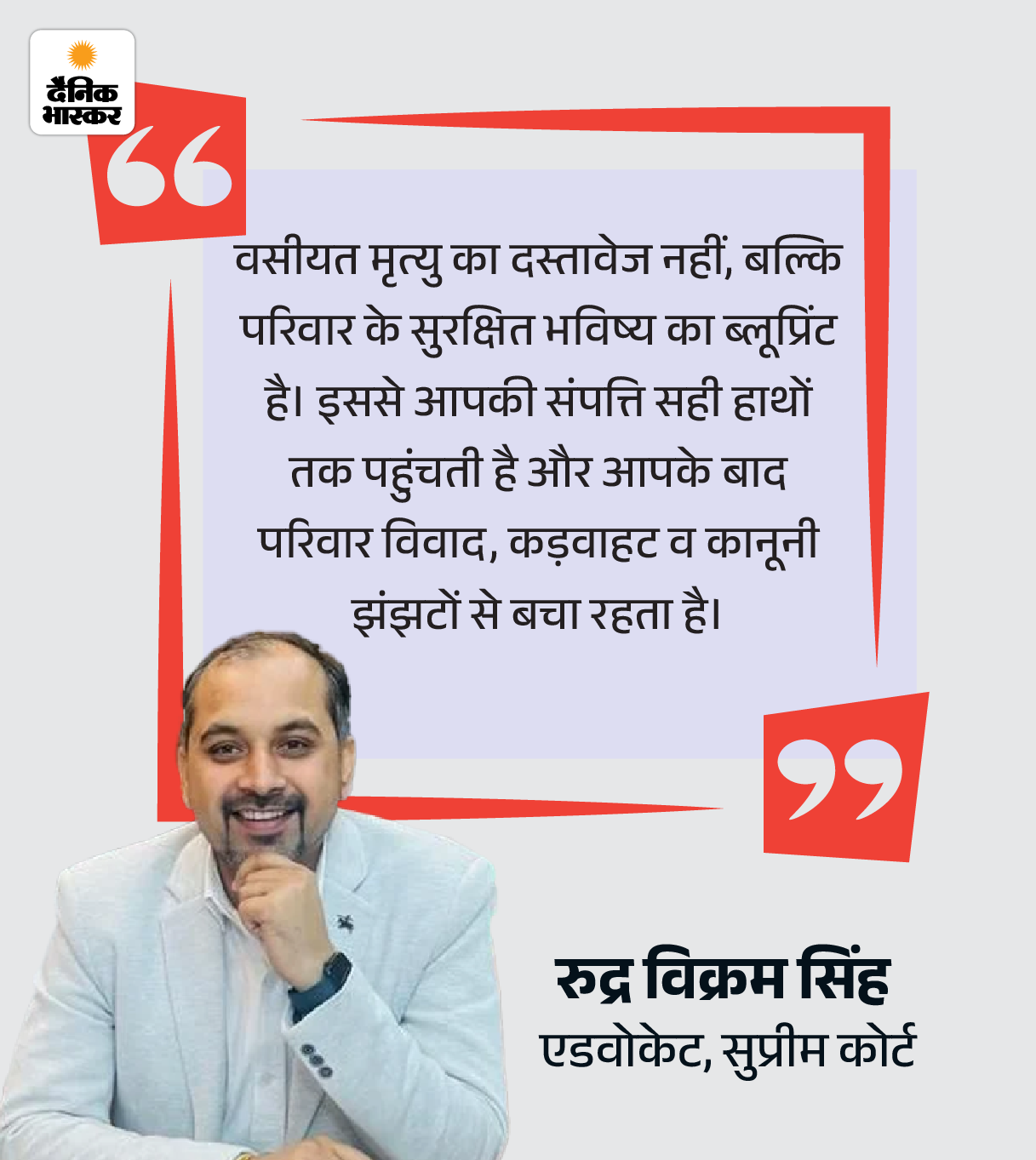
Expert: Rudra Vikram Singh, Advocate, Supreme Court
Question- What is a will?
answer- A will is a written legal document in which a person gives clear instructions as to who will own his property after his death. In this, distribution of bank balance, property, investments, jewelery and other assets is decided.
Question- Who can make a will?
answer- In India, any person who is 18 years of age or older and is mentally healthy can make a will. However, the person must be able to prove that he has prepared the document without any duress, fraud or inducement.
Question- Why is it necessary to make a will?
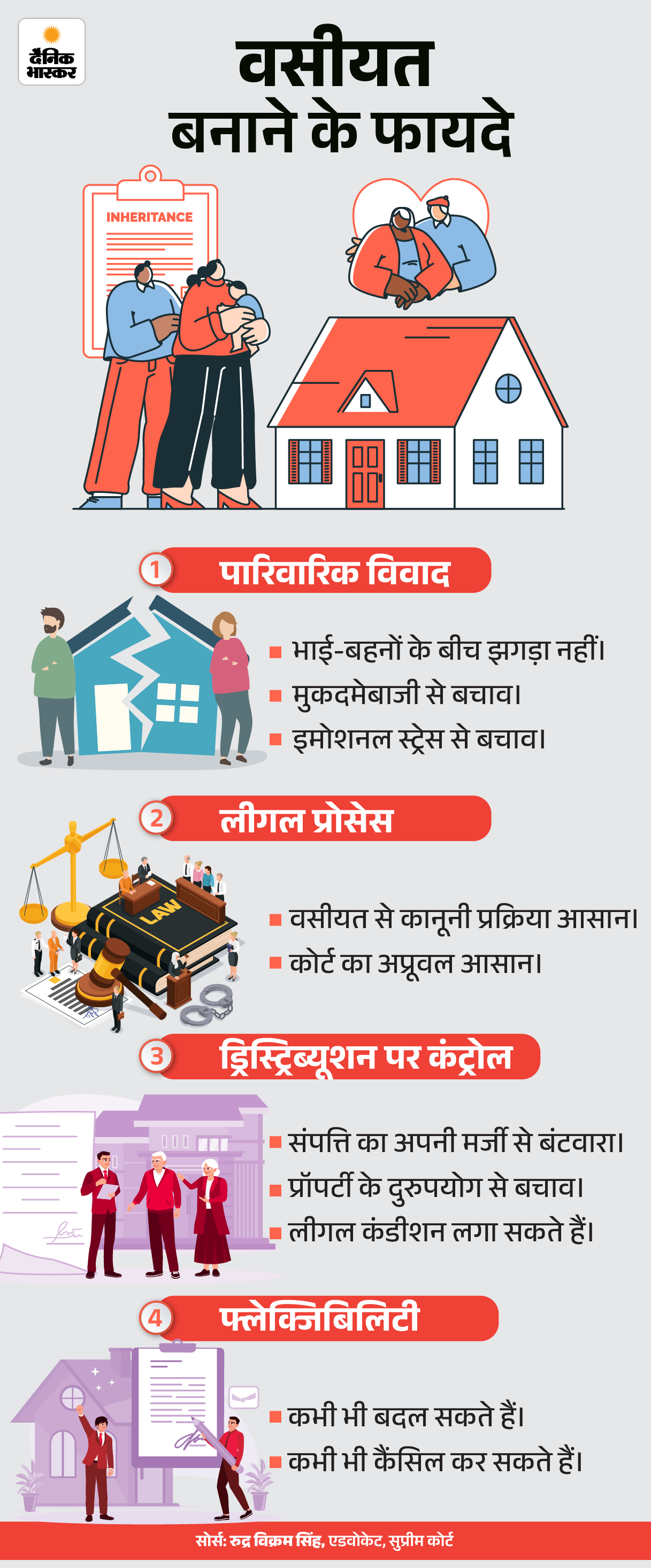
answer- With this a person can decide who will be the owner of his property after death. If a will is not made, the law distributes the property as per its own, which may be against the wishes of the person.
Apart from this, the possibility of dispute in the family is reduced with a will and the legal process also becomes simpler. This is especially important when there are multiple family members who are claimants to the property. See all its benefits in graphic-
Question- How to write a will?
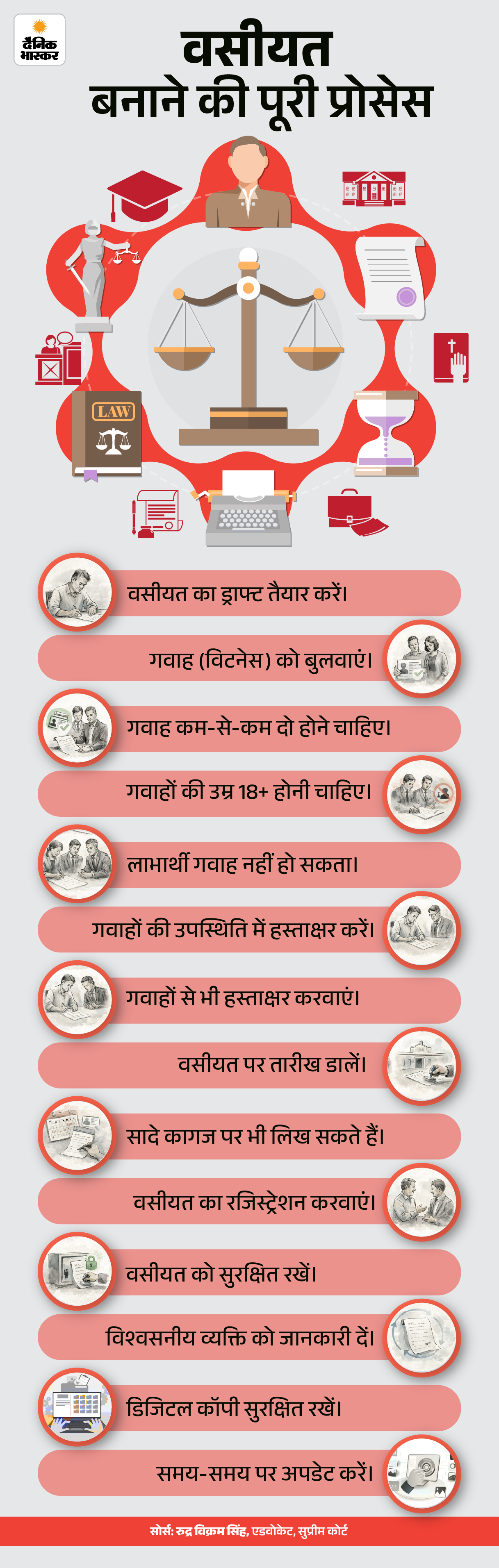
answer- There is no fixed format for writing a will, but it is important to follow some rules. Such as-
- First of all, the person has to declare that at the time of writing the will, he is of sound mind and is writing it without any pressure.
- After this he has to prepare a list of all his assets.
- It is important to clearly write on the will paper which property is to be given to whom.
- If the children are minor, it is important to name the guardian on the will, who will protect the property. Will hand over the children when they become adults.
Understand its entire process graphically-
Question- What information should be contained in the will?
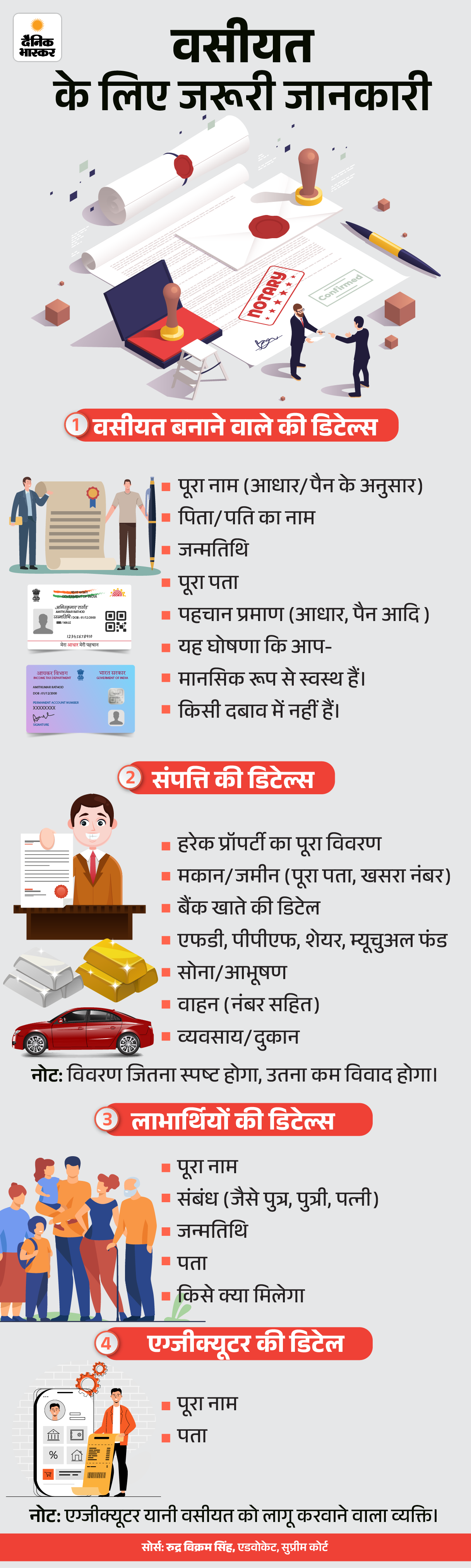
answer- Your personal and financial information should be clearly stated in the will. It should contain the full name, date of birth, address and identity information of the person writing the will. This information should be as per Aadhaar and PAN card.
In this, it is important to give details of all your movable and immovable assets, like house, land, bank accounts, investments etc. What other information is necessary in this, see in the graphic-
Question- Is it necessary to register the will?
answer- It is not mandatory to register a will in India. You can also make it legally valid by writing it on ordinary paper, provided all the necessary conditions are met.
However, registering the will increases its authenticity and makes it difficult to challenge in case of any dispute in future. Registration keeps the documents safe and reduces the possibility of tampering.
Question- What are the legal terms in the will? What do they mean?
answer- It contains many important legal terms. Let us understand them one by one.
- Testator- The person who is making the will.
- Executor- The person who will execute the will.
- Beneficiary- Who/who will get the property.
- codosil- Changes or amendments made to a will.
- probate- Confirmation of the will by the court.
- Intestat- If a person dies without writing a will.
- Question- What is Digital Will?
answer- A digital will is a document that is often kept secure online. It is written in it who will get the digital assets of the person after death, like-
- social media account
- cryptocurrency
- cloud files
- email account
- online banking account
- digital wallet
In this it is made clear who will get access to these accounts. It is as important in modern times as a traditional will.
Question- What will happen if the will is not written?
answer- If a person dies without writing a will, his property is distributed as per the law.
- Hindu Succession Law- For Hindus.
- Indian Succession Act- For Christians and Parsis.
- Sharia law- For Muslims.
In this situation, personal wishes are not given any importance and the property is distributed according to the prescribed legal rules.
Question- Can the will be changed?
answer- Yes, a will can be changed at any time while one is alive. If your property, family situation or wishes change, you can make a new will. This can also be amended.
As soon as a new will is made, the old will automatically gets cancelled. While making amendments, the same procedure has to be followed as in making a new will.
Question- Is the nominee the real owner of the will?
answer- No, the nominee is only a trustee and not the real owner. His job is to safeguard the property and pass it on to the rightful heir. The legal owner is the one whose name is mentioned as the beneficiary in the will.
Question: Can a will be challenged?
answer- Yes, a will can be challenged, but this happens only in limited circumstances, such as:
- If the will was written under pressure.
- If fraud has been committed.
- If the will was written due to mental instability.
- If the witnesses turn hostile.
- If the documents are unclear.
Therefore, it should be prepared with clear language, proper procedure and credible witnesses.
Question: Where should the will be kept safe?
answer- Keep the will in a safe place, but also make sure that it is easily accessible in your absence, e.g.
- bank locker
- any cupboard in the house
- to the lawyer
If the will is registered then its copy is deposited in the registrar office. The executor should be informed about this, so that he can implement it if needed.
Question- What happens to joint property?
answer- In joint property, you can write down only your share of the property in the will. For example, a husband or wife can divide only their share in the property. Therefore, write clearly in the will which property is individual and which is joint, so that there is no dispute in future.
……………… Read this news also Your money – What is ‘Senior Citizen Saving Scheme’: Regular income after retirement, know the interest rate, where and how to open an account
After retirement, the biggest question is how will the expenses be managed without regular income? If you have not done any pension planning in advance, then the problems may increase further. However, the good thing is that the Government of India has made many such schemes for senior citizens, through which they get a fixed amount every month. Read further…

&w=360&resize=360,240&ssl=1 "Why tell moons sayings to the moons? Where did these revise? Read here")

&w=360&resize=360,240&ssl=1 "High cholesterol can reduce the risk of these 4 taste fruits, in your Dock today")