

Last Updated:
In this modern era of military technology, missiles are no longer judged by how far they can fly, but also by how difficult they are to intercept. Among all existing weapons, one missile far lags all others in terms of range, speed, payload and ability to evade defense systems. The name of this missile is RS-28 Sarmat. It is considered to be the most powerful missile deployed anywhere in the world and is a Russian missile.
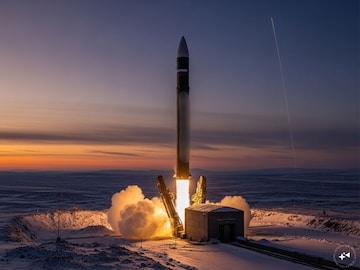
In this modern era of military technology, missiles are no longer judged by how far they can fly, but also by how difficult they are to intercept. Among all existing weapons, one missile far lags all others in terms of range, speed, payload and ability to evade defense systems. The name of this missile is RS-28 Sarmat. It is considered to be the most powerful missile deployed anywhere in the world and is a Russian missile.
Sarmat is an intercontinental ballistic missile. It was developed by Russia to replace the old Soviet-era Satan missile. Its most fearsome feature is its massive range of about 18000 km which allows it to hit almost any target on Earth. This range gives Russia the flexibility to strike from unconventional directions.
Speed is another reason why Sarmat is almost impossible to stop. This missile can fly at a speed of 25000 km per hour. At such high speeds, detection time is very short and it is almost impossible to intercept with current defense technology.
Also, the most dangerous aspect of this missile is its multiple independent targetable re-entry vehicle capability. A missile can carry 10 to 15 nuclear warheads. Each of these is capable of attacking a different city or military target. This means that a single launch can destroy multiple areas simultaneously.
The Sarmat Avangard can also carry a hypersonic glide vehicle. It is capable of changing direction mid-flight. Unlike conventional ballistic missiles that follow a predictable path, Avangard hypersonic glide vehicles maneuver at hypersonic speeds. This makes them almost impossible for existing missile defense systems to track or destroy.
Also, most of the world’s missile defense systems are centered around the North Pole because they expect attacks from that direction. Instead RS 28 Sarmat could reach the target via the South Pole. With this, gaps in radar coverage can be taken advantage of and the chance of interception can be further reduced.
New Delhi,New Delhi,Delhi
Jan 28, 2026 10:10 AM IST
&w=360&resize=360,240&ssl=1 "Fine of Rs 13,000 on breaking the cigarette smoking outside the house")
&w=360&resize=360,240&ssl=1 "Greece Earthquake- The large earthquake’s alert, army deployed, closed school for a couple of days")