

12 hours agoAuthor: Shivakant Shukla
- copy link
Book Name: ‘Emotion: Life’s GPS’ (Find your way with Bhavana Yoga)
Author: Munishri Pramansagar Ji Maharaj
Publisher: Nirgrantha Foundation
Price: 150 rupees
Today man has a sharp mind, modern means and many options for entertainment, yet he is confused. The reason is that we have learned to handle the outside world, but emotions are yet to be understood.
Jain sage Pramansagar ji’s book ‘Emotion: GPS of Life’ throws light on this subject. It teaches that the real direction of life is not decided outside, but within.
Munishree explains that if we learn to understand and control our emotions, then personal and professional success is not far.
Munishree tells that-
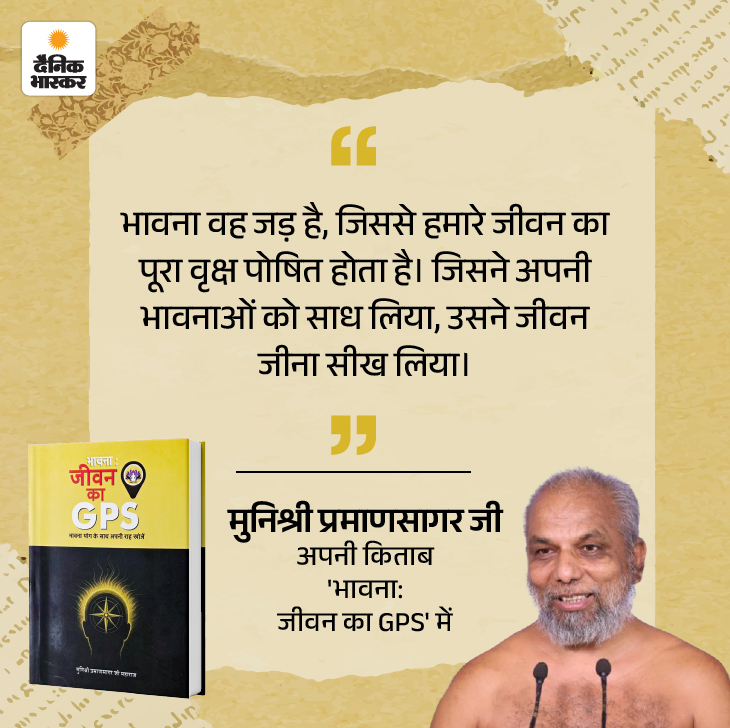
“Emotion is that invisible stream of consciousness, which gives direction to our life. Emotions play a role in what we think, what we decide and what we become.
Purpose and importance of the book
- The aim of the book is to make a person ‘acquainted with his feelings and give them the right direction’.
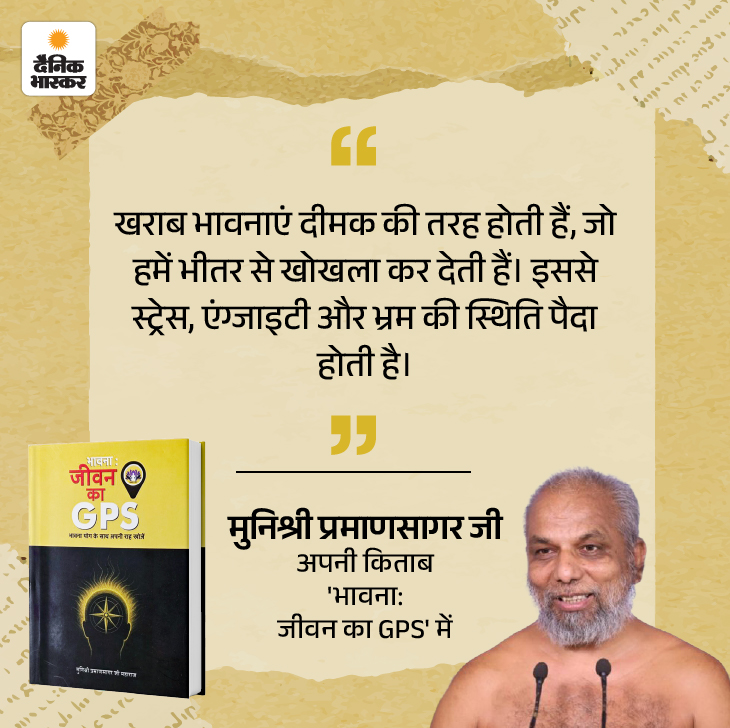
- The book explains that most of life’s problems, ‘be it stress, bitterness in relationships or difficulty in taking decisions’, have their root cause due to uncontrolled emotions.
- Most of the decisions in our life are driven by emotions, not logic.
- Only when we understand and purify and balance our emotions does real change occur.
- Through the process of Bhavana Yoga, this book moves a person towards self-reflection, self-purification and self-growth.
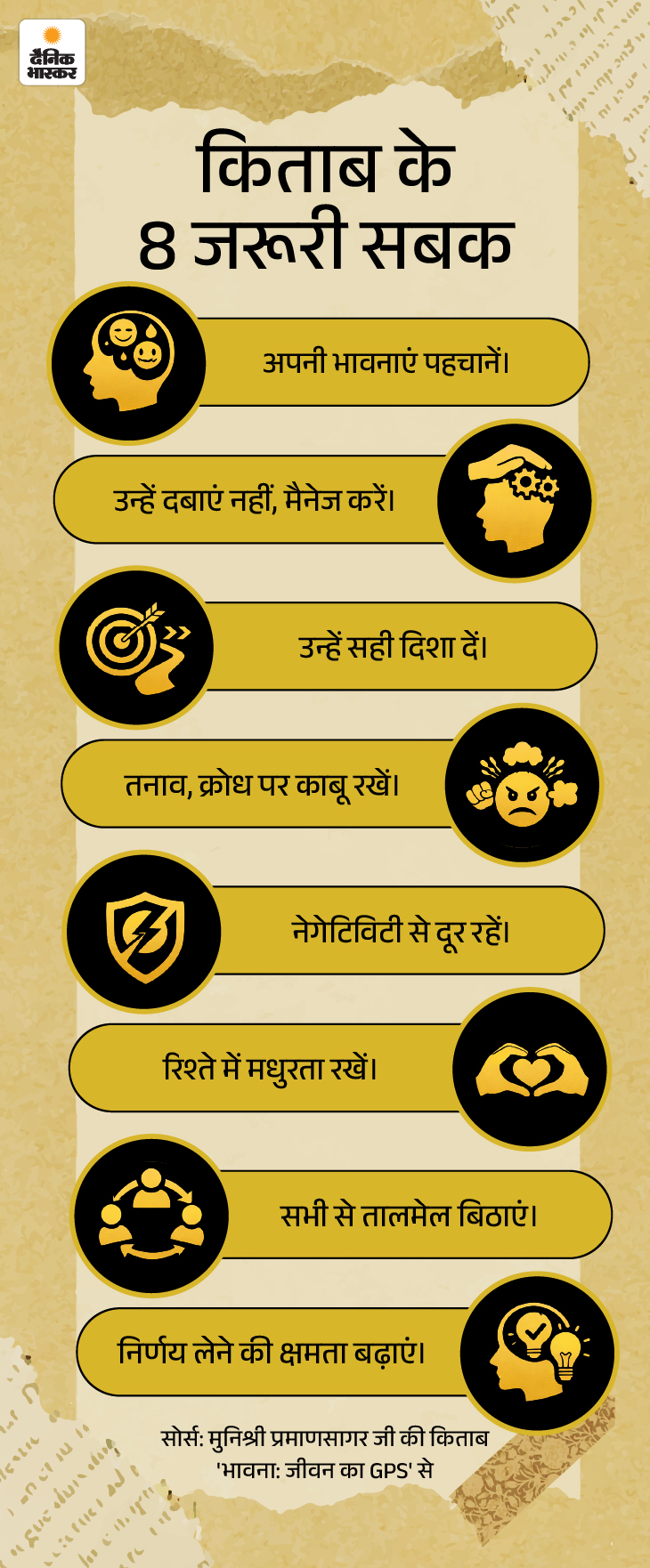
See the 8 important lessons of the book in the graphic below-
Emotions are explained in three levels in the book-
- physical feelings (hunger, fatigue, fear)
- mental feelings (jealousy, expectation, disappointment)
- spiritual feelings (compassion, peace, forgiveness)
Munishree explains that emotions are neither good nor bad. Their direction is what makes them positive or negative.
Negative emotions: the root of the problem
An important part of the book is ‘Recognition of distorted emotions’. Munishree explains how our ‘pure emotions’ get distorted and harm us. Such as-
- Love gets distorted and turns into attachment (possessiveness and fear of loss).
- Self-esteem gets distorted and turns into ego.
- Compassion gets distorted into ‘pity of inferiority’.
- Caution distorts into fear and anxiety.
- Self-defense gets distorted into anger and revenge.
- This part explains that problems arise not from external but from internal emotional distortions.
The Four Pillars of Emotion: A Life Changing Process
In the book, Bhavana Yoga has been explained in four steps-
- Prayer- Positive start.
- Pratikraman – Self-analysis and purification.
- Pratyakhyaan- Resolve to give up negativity.
- share – Living in the present and witnessing.
These four stages form the process of self-transformation. These can be easily adopted in everyday life.
Prayer
In Jain philosophy, prayer is not just asking for something from God, but also being aware of feelings and accepting them. When the person understands what he is feeling then a feeling of surrender develops. It reduces ego, increases self-awareness and initiates inner transformation.
pratikraman
Pratikraman is a process of self-analysis and emotional purification. In this, the person recognizes negative emotions (such as anger, fear, jealousy or guilt), understands the reason and tries to leave them. It lightens the mental burden and creates space for positivity.
repudiation
Pratyakhyaan means recognizing mistakes and negative patterns and resolving to avoid repeating them. It is not limited to thinking, but brings changes in behavior. This strengthens self-discipline and the person moves in a better direction.
shared
Samayik is the state where a person remains stable in the present and lives with a witnessing attitude. There is neither the burden of the past nor the worry of the future. The mind remains calm and balanced. This is the state of equanimity, which is considered the final achievement of Bhavana Yoga.
How to do self management?
This book is not limited to the theory of emotions only. It explains how emotions affect every part of everyday life. The author divides self-management into five areas, which are the basis of making life organized and balanced.
- thought management
Our thoughts decide our direction. The book teaches how to move away from negative and wasteful thinking and develop positive and solution-focused thinking.
- price management
It is important to recognize and understand every emotion. When we know what is going on inside at this moment, then we become not slaves of emotions, but their controllers.
- voice management
Words are not just sounds but carriers of emotions. The author explains that speaking thoughtfully, restrainedly and sensitively improves relationships.
- action management
Our actions are motivated by emotions. If emotions are balanced, decisions and actions go in the right direction.
- energy management
Our mental and emotional energy is limited. The book teaches that investing in the right place instead of spending it in unnecessary worry and negativity makes life effective.
Five golden tips to strengthen relationships
One impressive aspect of the book is its perspective on relationships. Munishree says that relationships do not run only on logic and reason, but are based on the foundation of emotions. Five golden formulas have been given to strengthen it.
- Dialogue: Not just speaking, but listening and understanding from the heart is true communication.
- Self-reflection: It is important to look within yourself (what am I feeling and why?) before reacting.
- Co-existence: Every person is different, the beauty of relationships is to accept them instead of changing them.
- Forgiveness and humility: Ego breaks relationships, while forgiveness and humility bind them.
- conscious effort: One should always make efforts in relationships.
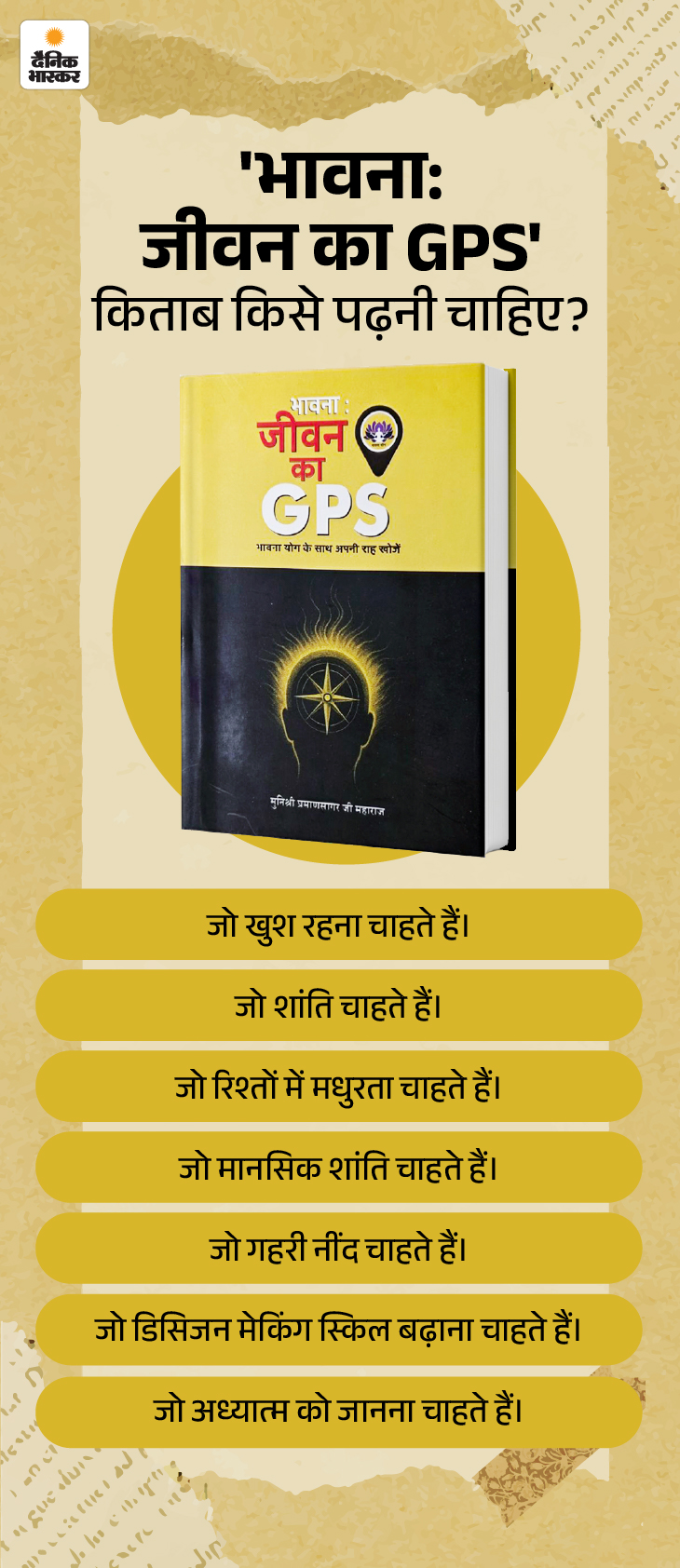
Why should you read this book?
If you want to understand emotions, this book is for you. This may also serve as a lesson for some people. Understand this from the graphic below-
My opinion about the book
The language of the book is a bit difficult, but you can understand it after reading. There is emphasis on practice, not just knowledge. Also questions have been given for self-reflection. Every aspect of life, emotion, health and relationship is covered.
……………
Also read this book review
Book-Review- Years of hard work behind one day’s success: Nothing happens overnight, how to move ahead so that you do not get tired, do not lose, do not get surrounded by disappointment.
Everyone wants a better life, where there is sweetness in relationships, balance in work and peace within. But it is difficult to find this balance in a fast-paced life. Famous life coach and saint Gaur Gopal Das’s book ‘The Amazing Secrets of Life’ teaches to create this balance. Read full review…

-
Book Review- Exciting Stories of Mossad: How Israel’s intelligence agency carried out the world’s most dangerous mission, read in this book
Play video
- copy link
share
-
Book Review: Strength is not outside, but within: Every day is a new opportunity to learn something, win, be humble, unlock the power of your mind
Play video
- copy link
share
-
Book Review- From Feeling to Healing: Whatever you feel, do not suppress it, understand it and give it the right direction, this is what the book ‘Feel to Heal’ teaches.
Play video
- copy link
share
-
Book Review- ‘Flight Plan’ to reach the destination: Difficulties will come, but how to fight them, this book tells the secret
Play video
- copy link
share


&w=360&resize=360,240&ssl=1 "Don’t even hold on the refrigerator this 5 items, so will great loss! – News-Patiala English")
