

10 hours agoAuthor: Aditi Ojha
- copy link
“Bus People do binge watching on TV with the thought of “one more…last episode”. Despite being tired all day long, one never realizes when an episode turns into several hours. The result of this is that one is unable to get enough sleep and remains lethargic the next day. If this routine continues for a long time, it can affect both the body and the brain.
According to a study published in the ‘European Psychiatry Journal’, if the time spent watching TV daily is reduced, the risk of depression can be reduced to a great extent.
so today ‘News of need’ I will know that-
- Why does watching too much TV increase the risk of depression?
- What effect does it have on sleep?
- How long is it safe to watch screens every day?
Expert: Dr. Jaya Sukul, Clinical Psychologist, Noida
Dr. Rohit Sharma, Consultant, Internal Medicine, Apollo Spectra Hospital, Jaipur
Question- Does watching TV increase stress?
answer- Yes, watching negative, violent or high-drama content for long periods of time keeps the brain in constant alert mode. Due to this, stress hormones are released, sleep gets disturbed and gradually irritability and mental fatigue starts increasing.
Question- Can watching too much TV cause depression?
answer- No, watching too much TV does not directly cause depression, but it can definitely increase the risk.
- Staying in front of the screen for a long time reduces physical activity.
- Meeting people decreases.
- Sleep is bad.
These three things are associated with the risk of depression.
Question- What does the recent study say about TV watching habit and depression?
answer- Researchers from the University of Groningen conducted a study. According to this, reducing the time of watching TV reduces the risk of depression. Research conducted on more than 65 thousand people for 4 years found that watching TV 1 hour less every day can reduce the risk of depression by about 11%. By reducing the risk of depression by 1.5 hours, the risk of depression can be reduced by about 26% and by reducing it by 2 hours, the risk of depression can be reduced by about 40%. Its maximum effect was seen in people between 40 and 65 years of age. This study has been published in the European Psychiatry Journal.
Question- Does watching too much TV have a bad effect on sleep? If yes, why?
answer- Yes, the bright blue light emanating from TV and mobile screens signals the brain that it is day. Due to this, the sleep hormone melatonin is produced less. Due to this, sleep comes late or does not come at all. This can disturb the body clock (sleep-wake timing). See all the health risks arising from this in the graphic-
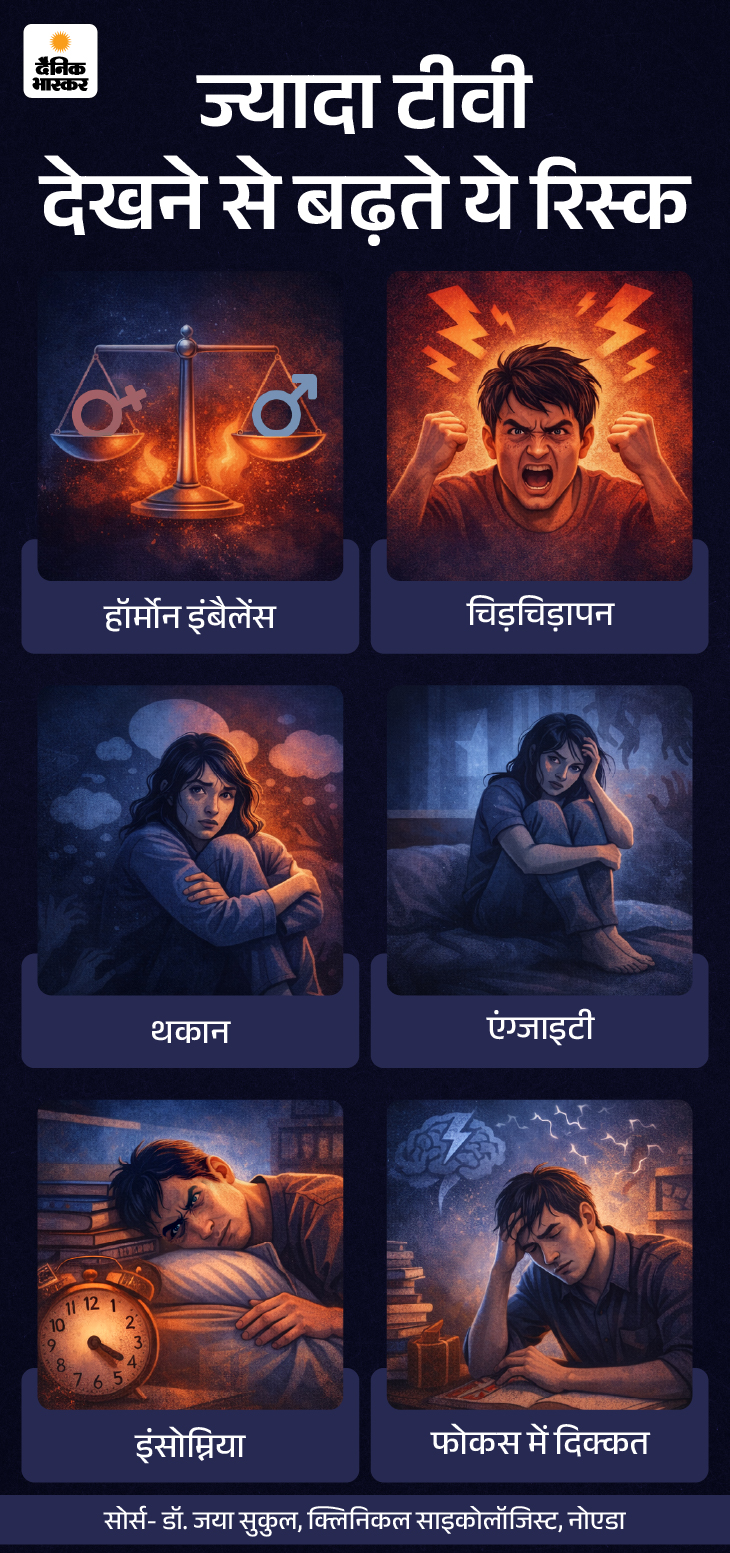
Question- What effect does watching too much TV have on physical health?
answer- This has serious effects on physical health. Understand by pointers-
- This reduces physical activity.
- Metabolism slows down.
- Weight starts increasing.
This habit can gradually increase the risk of many serious diseases. Look at the graphic-
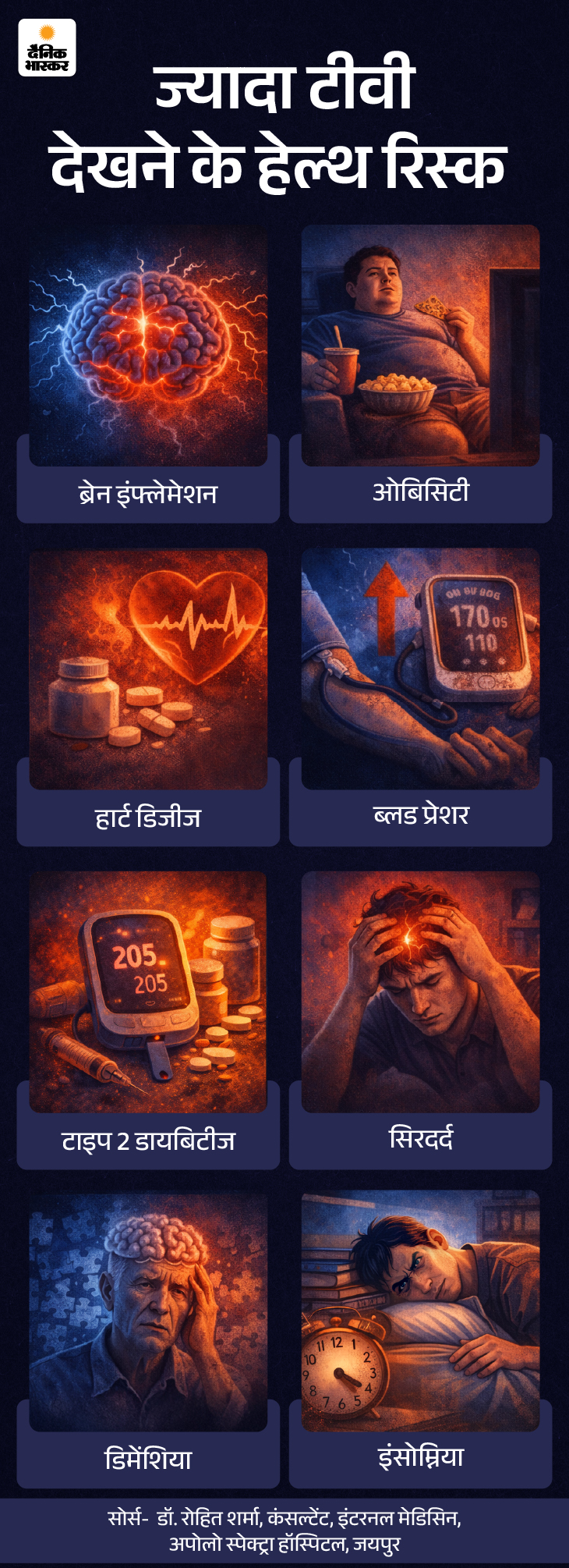
Question- What effect does watching too much TV have on mental health?
answer- Let us understand this from pointers-
- Due to this, people’s social interaction reduces, which can increase loneliness and sadness.
- Binge-watching increases the risk of anxiety and depression.
- Gradually one becomes addicted to watching TV. This makes the brain want to see new content again and again.
- Watching scary or too perfect life content can create insecurity and reduce self-confidence.
Question- Can munching while watching TV also increase the risk of depression?
answer- Munching means eating something while watching TV or screen. During this time most people eat junk food.
- This makes one feel energetic and good for some time. But after this the body suddenly releases more insulin, due to which the sugar level goes down rapidly.
- During this time, the brain does not get enough energy, which causes fatigue, irritability and mood down.
- If this happens again and again, fluctuations in mood increase and gradually one starts feeling sadness. This sadness increases the risk of depression.
Question- Is television addiction a real mental health concern?
answer- Yes, watching TV too much and out of control can be a serious mental health concern.
Question: How many maximum hours per day is it safe to watch TV?
answer- In general, 1-2 hours of screen time for entertainment per day is considered a balanced amount of screen time for adults, provided it does not interfere with sleep, exercise and work.
Question: Does physical activity reduce the risk of depression?
answer- Yes, when walking, running, yoga or doing any kind of physical activity, endorphins and ‘feel-good’ chemicals (like serotonin, dopamine) increase in the body. These improve mood. This keeps stress hormone (cortisol) under control and also improves the quality of sleep. Both of these are important factors related to depression.
Question- How can the negative effects of watching TV be reduced?
answer- For this, first of all it is important to limit screen time. See all the necessary precautions in the graphic-

Question- What changes occur in mood, focus and mental energy by reducing TV time?
answer- Understand by pointers-
- Reducing TV time often improves sleep quality and stabilizes mood.
- When screen stimulation is reduced, the brain gets a break from the habit of constantly consuming new content. This can reduce irritability and mental fatigue.
- Focus is also improved, as frequently changing visuals limit focus.
Question- If you have the habit of watching too much TV, then how to reduce it?
answer- If the habit of watching TV starts getting out of control, then it is a better way to reduce it with a plan rather than quitting it suddenly. Small but firm steps gradually weaken this habit. Understand by pointers-
- Take a 30 day no TV challenge.
- Delete cable/OTT.
- Keep the TV in the store. When TV is not watched then less will come to mind.
- Turn fixed TV time into a new hobby time.
- Create a reading corner.
- Set a no-screen rule at home.
- Every time you feel like watching TV, do something else for the first 10 minutes.
- Stick a poster of your goals on the TV.
……………………………..
Read this news also…
News of need – Academic stress in children: Due to this, the risk of depression and diseases increases in youth, know from the doctor how to prevent it.
Board exams have started. As soon as this season arrives, there is an atmosphere of worry about syllabus, test series, revision plan and results in millions of homes. It is normal to have mild stress in studies, but when its pressure starts affecting both the mind and body continuously, it can become a serious problem. Read the full news…


&w=360&resize=360,240&ssl=1 "Read before buying cucumber in summer will be important from buying, a bitter cucumber, the domestic measure of removing bitterness")
