

- Hindi News
- Lifestyle
- Emotional Loneliness Meaning Signs Explained; How To Overcome | Mental Health
11 hours ago
- copy link
Question- I am 23 years old. I live in Ranchi and am doing a course in hotel management. We are a joint family. I have lots of friends in college also. Still, I feel a strange loneliness all the time. There are people around me all the time and I want to run away from them all and be alone. I feel that no one is mine. Be it friends or family, no one understands me. I look happy on the outside, but I am sad on the inside. Does everyone feel this way? Is this feeling normal or is there a problem within me?
Expert – Dr. Dron Sharma, Consultant Psychiatrist, Ireland, UK. Member of the UK, Irish and Gibraltar Medical Councils.
Thank you very much for asking the question. Emotional loneliness has become an important topic of mental health discussion today. At first glance it seems like simple ‘loneliness’, but psychology understands it much more deeply.

What is emotional loneliness?
Robert Wise’s work on this topic is considered foundational in modern psychology. He explained in 1973 that loneliness is not a single experience. There are different types of it. This experience may be different for every person.
According to Vice, one form of loneliness is when a person does not have a close, trusting, and emotionally safe relationship in which he can express himself openly. This is called emotional loneliness.
The second form is when the person does not have a wide social circle, such as family, friends, acquaintances or community. This is called social loneliness.
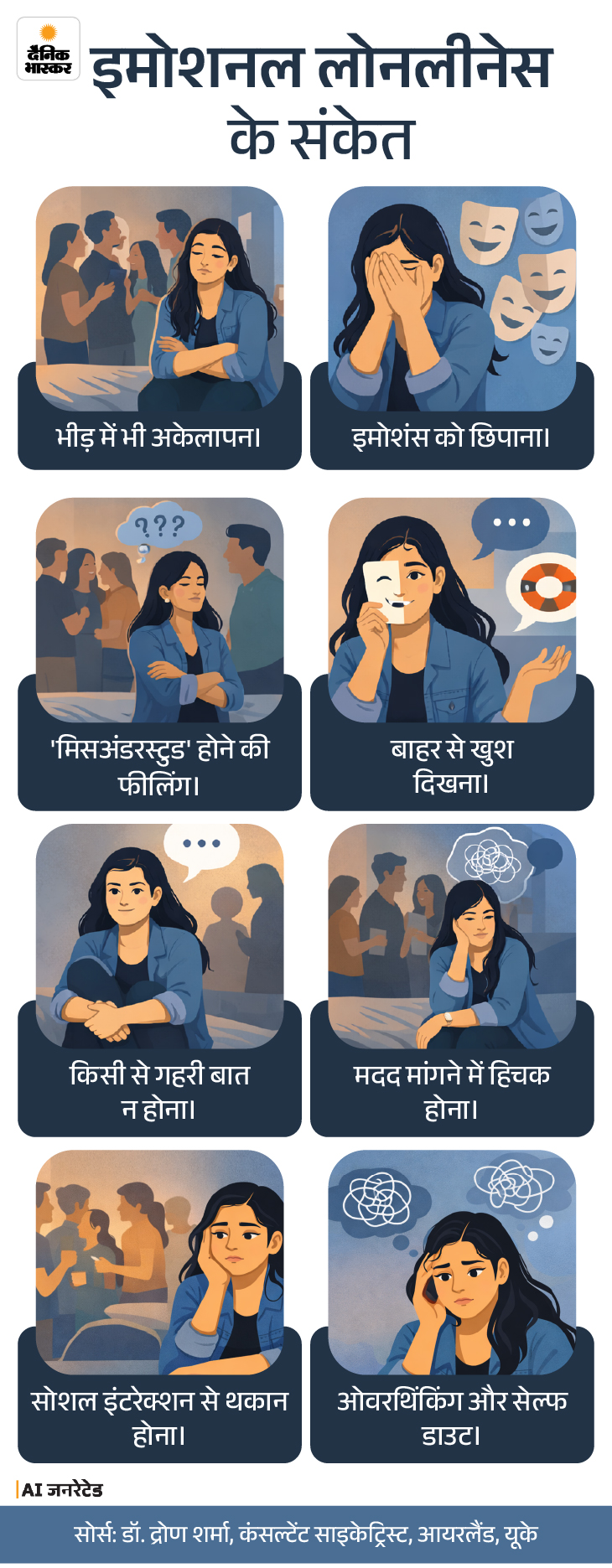
loneliness in the crowd
Later, two famous New Zealand sociologists, Jenny de Jong Heerfeld and Theo Van Tilburkh, further clarified this difference and developed several scientific tools to measure it.
Today emotional loneliness is not just ‘being alone’. Emotional loneliness means feeling that despite being surrounded by people and being in a crowd –
- Nobody understands me.
- No one listens to me.
- Nobody loves me.
In this context, it is important to understand the difference between emotional loneliness and social loneliness. Many times the person has a family, friends, and is also socially active.
For example, a person may live in a joint family, have many friends in college, and be often surrounded by people. Despite this, if there is a constant feeling of emptiness, distance or “no one understands me”, then it is a sign of emotional loneliness.
In social loneliness the person’s main complaint is—”I don’t have people.” On the contrary, in emotional loneliness the person says – “There are people, but no one is really mine.” This difference is very important, because it explains the root of the problem. The challenge here is not the number of people, but the quality of relationships.
In such cases the person often also feels that
- Social contact tires him instead of relaxing him.
- He is unable to connect emotionally even while being among people.
- Thoughts like “No one understands me” indicate that one’s experiences are not being understood and accepted, which is called a lack of “emotional attunement” in psychology.
someone who will listen and understand us
Thus, emotional loneliness helps us understand that just being surrounded by people is not enough. For mental balance and satisfaction, it is important to have such relationships in our life, where we can express our true feelings without hesitation and feel truly understood.

Are you emotionally alone?
Do self assessment test
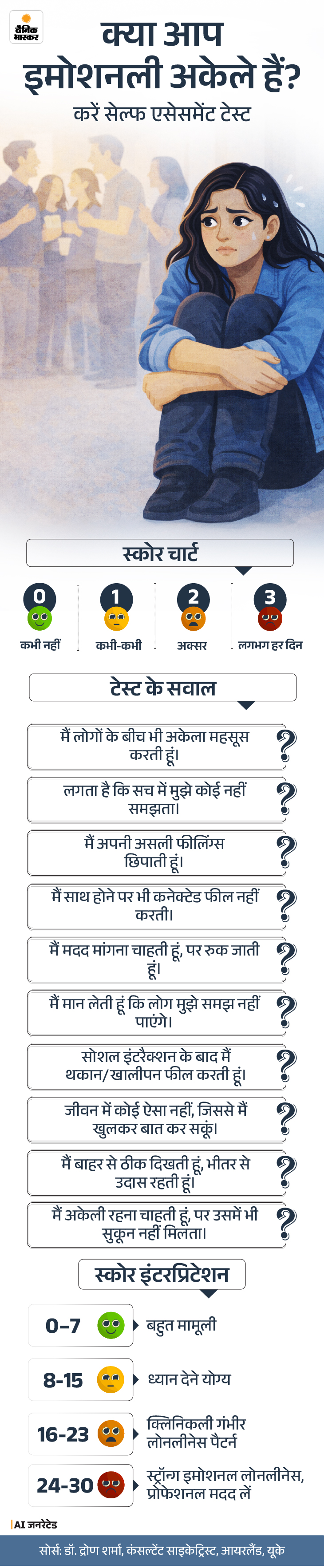
Here I am giving you a self assessment test. There are total 10 questions in the graphics below. You have to read these questions carefully and rate it on a scale of 0 to 3. For example, for the first question, if your answer is ‘never’ then give 0 marks and if your answer is ‘almost every day’ then give 3 marks. Finally analyze your total score.
Its interpretation according to the numbers is also given in the graphic. If your total score is between 0 and 7, you have a very mild pattern. This is normal but if your score is between 24 to 30 then it is a sign of very strong emotional loneliness. In such a situation, one should think about professional help. See the detailed test in the graphic below.
Is this low mood/depression?
Apart from this assessment test, it is also important to see whether it is a case of low mood/depression. Therefore, ask yourself these two questions –
- Has this feeling of loneliness continued for more than two weeks?
- Are these things also getting affected with this feeling –
- Sleep
- hunger
- studies
- energy level
Apart from this, is this also happening –
- There is a lot of crying in between.
- Feeling disappointed.
- Thinking of harming myself.
If your answer is “yes”, then low mood/depression should also be looked at through a professional lens. Both the HSE (Health and Safety Executive, UK) and the NHS (National Health Service, UK) recommend seeking professional help if you have persistent low mood for more than 2 weeks, have difficulty coping, or self-help does not help.
4 Week CBT Based Self Help Plan
week 1
recognize and explain
Goal: Naming the feeling, not suppressing it
Your goal in the first week is not to suppress your feelings, but to identify and name them.
Fill out a short mood log at least once a day, writing down four things:
- Situation (what happened)
- Thought (what came to mind)
- Feeling (what felt)
- Need (What did you need from inside)
Example:
- Situation- Was with friends.
- Thought- no one understands me.
- Feeling- Feeling empty.
- need- A real conversation.
Apart from this, sit peacefully for 10 minutes every day and ask yourself-
“What am I feeling right now?”
Note that feeling without judging.
week 2
testing ideas
Goal: Do not believe the automatic negative thoughts, examine them.
Your goal this week is not to directly accept your negative thoughts (which come automatically) as true, but to examine them and challenge them.
Like this automatic thought came to your mind-
- “Nobody is my own.”
- “Nobody understands me.”
Whenever such a thought comes, make a CBT worksheet and write in it-
Party- What evidence is there to support this idea?
Opposition- What is the evidence against this idea?
balance- What could be a more balanced and realistic thinking?
Example:
Thoughts: “Nobody understands me.”
Party: I don’t share my things.
Cons: A friend and father try to understand many times.
balance: “Maybe not everyone understands, but if I’m open, some people might.”
week 3
Behavior Testing and Connection Building
Goal: test belief in real life
Your goal this week is to test your old beliefs in real life. Like your belief – “No one will understand me.” For this, do three small experiments:
- Have a 10-minute honest conversation with a friend.
- Share a line with a trusted family member—“I look fine on the outside, but I feel low on the inside.”
- Instead of talking to too many people in a group, focus on having meaningful conversations with just one person.
Write three things after every experiment:
- What did I think first?
- What actually happened?
- How did I feel before and after?
week 4
Emotional needs and preventing relapse
Goal: Not just reducing loneliness, building safe relationships
The goal of this week is not just to reduce loneliness, but to create true and safe emotional connections. First, identify and write down your top 3 emotional needs. Such as-
- “Let me be heard.”
- “I should not be judged.”
- “Get consistency or familiarity.”
Then make a small relationship map, so that you can understand which person plays which role in your life.
- Who is just there for fun?
- Which is a safe space?
- Who gives advice?
- Who is emotionally available?
After this make a simple weekly plan:
- General contact (call/message) with 2 people
- meaningful conversation with one person
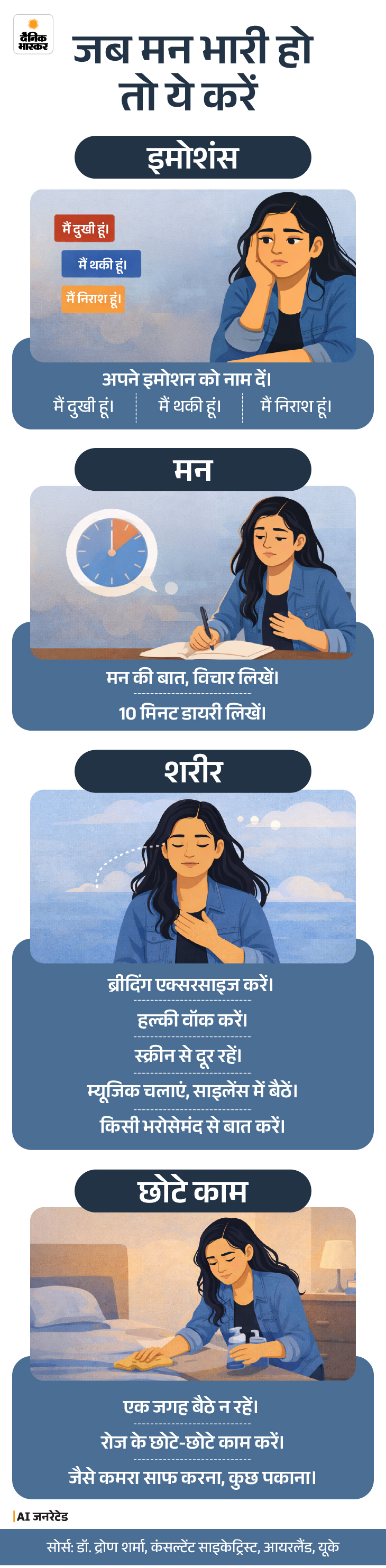
- 3 happy, calming activities (like walking, journaling, listening to music)
- 1 Creating boundaries (immediately setting limits on things you don’t like).
Apart from all this, repeat these sentences to yourself-
“There is nothing wrong with me. My emotional needs are not met.”
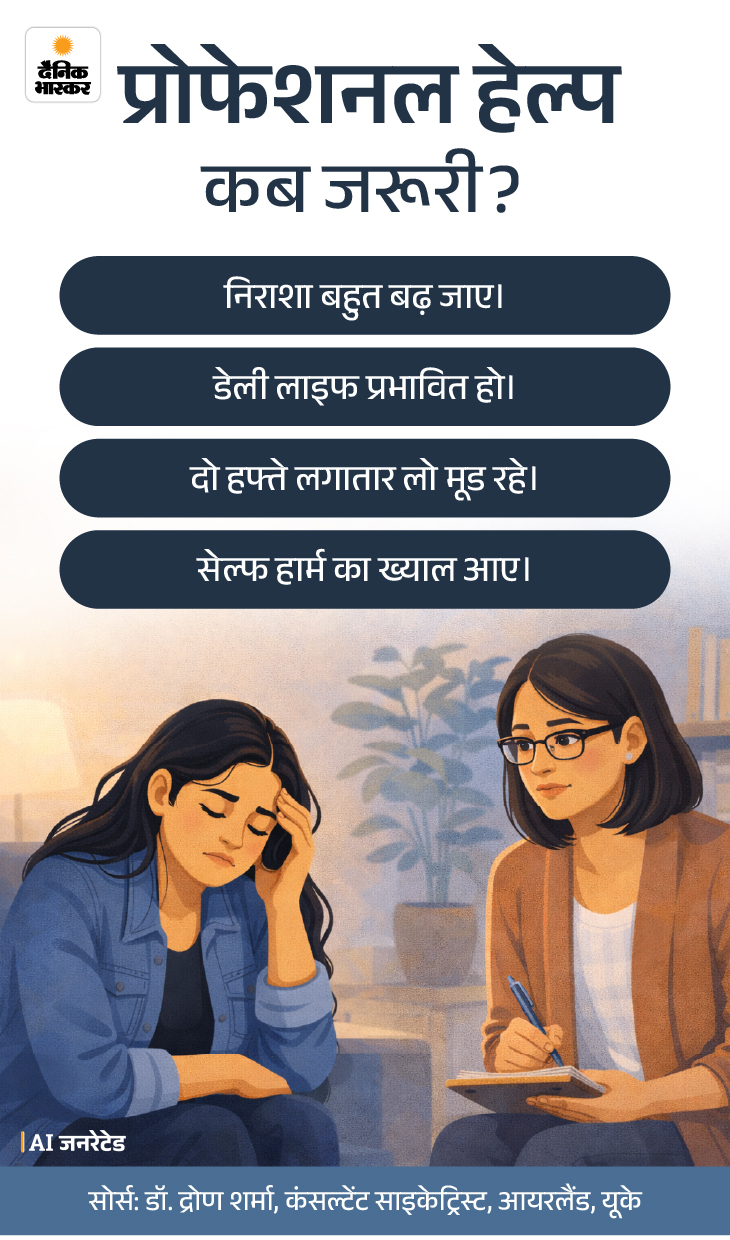
When is professional help necessary?
If any two of the four signs given in the graphic below are seen together, seek professional help. The thought of harming yourself in any way is especially alarming. In such a situation, consult a psychiatrist immediately.
last thing
Loneliness is not just the lack of people in life, but the lack of true, deep emotional connection. This is not a sign of your weakness, but of an unmet emotional need. With openness, proper understanding and small efforts, you can gradually build secure, deep and balanced relationships. You can also connect deeply with yourself.
……………… Read this news also Mental Health – I overthink all the time: I cannot control my brain even if I want to, I remain worried, how to get out of this?
Overthinking is a mental process in which a person thinks excessively about even small incidents and makes them a big deal. This habit gradually increases anxiety and insecurity. This creates self-doubt. A person is unable to differentiate between a fact and his interpretation of that fact. It affects both emotions and behaviour. Read further…


&w=360&resize=360,240&ssl=1 "Before wedding, the greedy family knows will be known already!")
