

- Hindi News
- Lifestyle
- Doxing Scam Alerts; I4C Indore Teacher VIDEO | Trolling, Threatening Call Messages Cyber Rules
10 hours agoAuthor: Shivakant Shukla
- copy link
Condition Recently, the Indian Cyber Crime Coordination Center (I4C) has alerted people about ‘doxxing scam’. Doxxing means making a person’s personal or identifying information public on the Internet without his or her consent.
I4C has mentioned in the video an incident from Indore, where a student shared his teacher’s personal information (like name, address, phone number and other details) on public platforms. Also instigated people to harass them online and offline.
After this the teacher had to face trolling, threatening calls-messages and a lot of insults. In such a situation, the question arises whether anyone can share someone’s personal information on public platforms without consent. Is there any law for this?
Come on, today needed news We will talk about this in detail. You will also learn that-
- Is it a legal offense to leak someone’s personal information online?
- What are the risks of personal information being leaked?
Expert: Rudra Vikram Singh, Advocate, Supreme Court
Question- Is it a legal offense to leak a person’s personal information online?
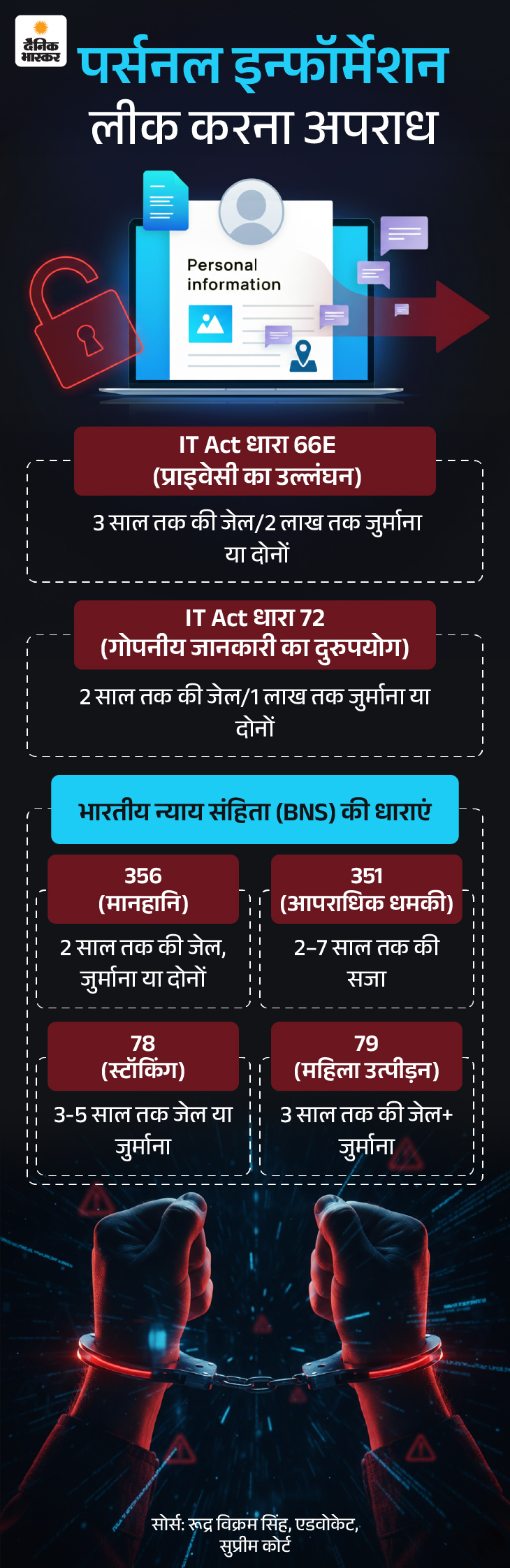
answer- Yes, leaking any person’s personal information online without his consent is a legal offense. This comes under the category of cyber crime. In such cases two sections may apply.
- Section 66E of the Information Technology Act, 2000 – Violation of privacy.
- Section 72 of the Information Technology Act, 2000 – Misuse of confidential information.
The matter becomes more serious if the leaking of information is accompanied by defamation, bullying or harassment. In such a situation, sections related to defamation, criminal intimidation and harassment under the Indian Judicial Code (BNS) may apply. If found guilty, the punishment may be fine, imprisonment or both.
Question- Which section of the law is applicable to the accused for leaking personal information and what is the punishment for it?
answer- In such cases, mainly sections of the Information Technology Act, 2000 (IT Act) and the Indian Justice Code, 2023 (BNS) may be applicable. Understand this from the graphic given below-
Question- What are the possible dangers of personal information leaking?
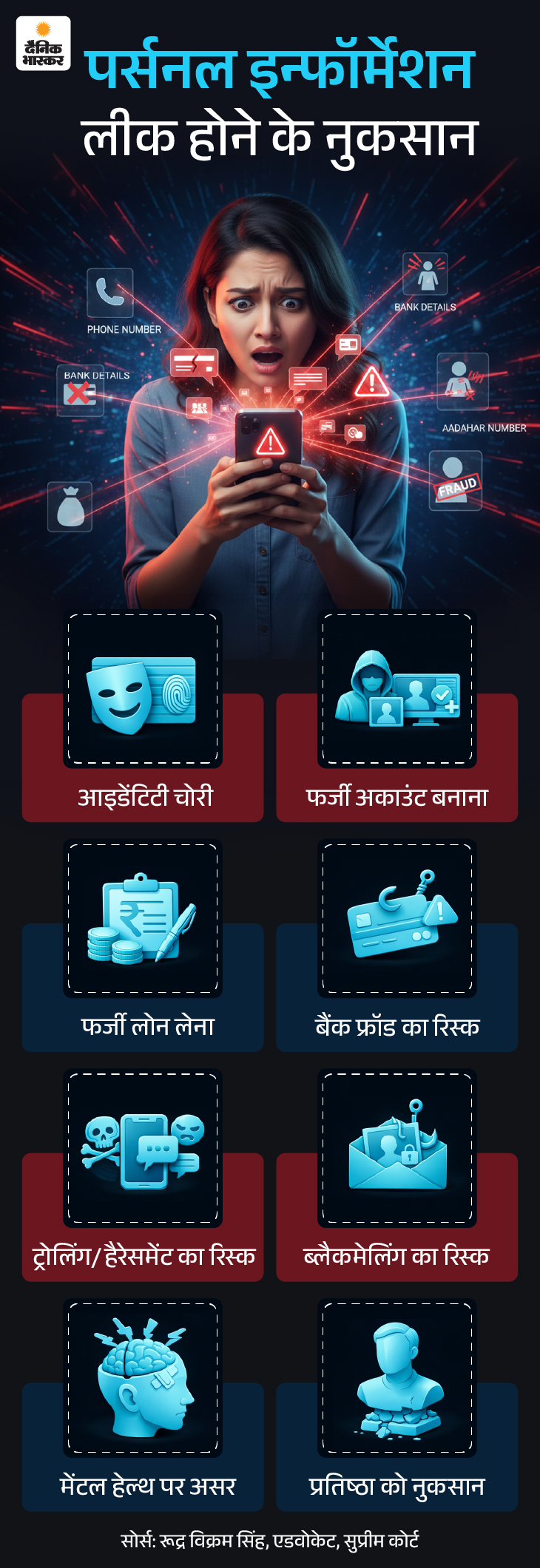
answer- This can lead to serious risks like identity theft, financial loss, mental stress and social stigma. In many cases people also become victims of trolling, blackmailing and threats. Understand this from the graphic given below-
Question- If someone’s personal information gets leaked, what steps should he take immediately?
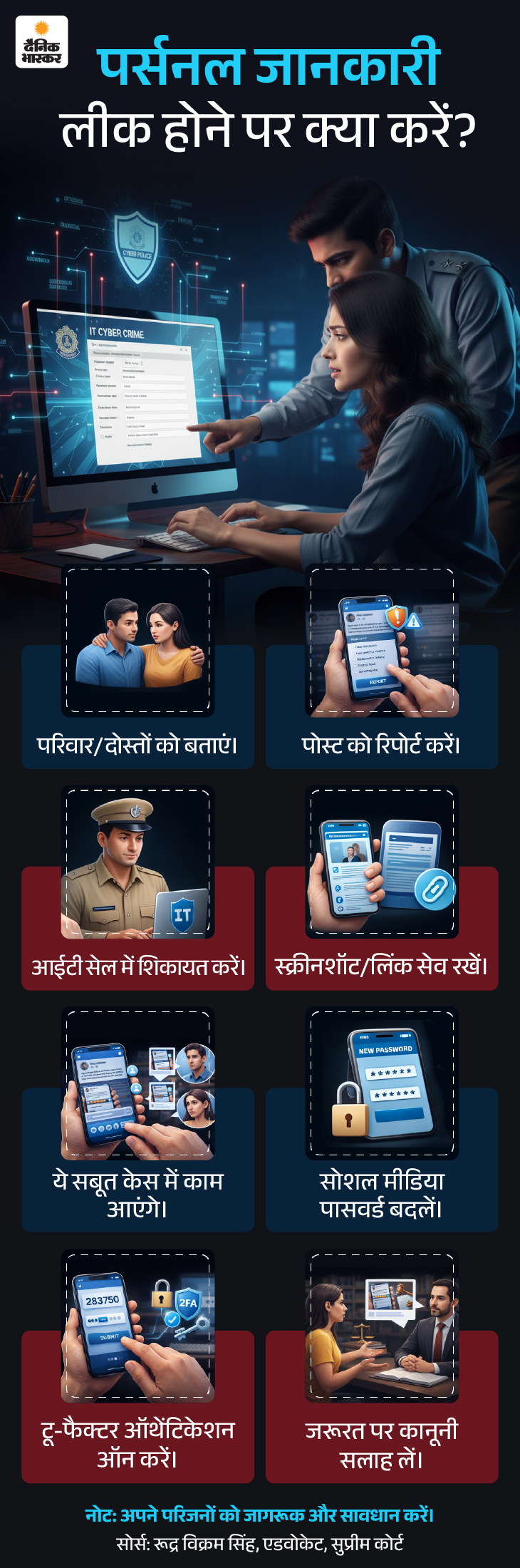
answer- In such a situation, instead of panicking, it is important to take immediate action. First of all, keep screenshots and links of leaked information safe, so that they can serve as evidence later. Immediately report to the administrator of the platform on which the information has been shared and demand removal of the content.
Change the passwords of your social media and email accounts. Also turn on two-factor authentication, so that such misuse can be prevented further. Also inform family and friends, so that they do not fall into any trap. If necessary, lodge a complaint with cyber crime portal or police. Understand this from the graphic given below-
Question- How to keep your online data and information safe?
answer- In today’s digital era, social media accounts have become our identity. In such a situation, even small carelessness can lead to bank fraud, hacking or data theft. Therefore, it is very important to adopt some basic precautions. Such as-
- Keep social media passwords strong.
- Never share OTP with anyone.
- Always keep two-factor authentication on in your phone.
- Do not use social media and banking apps on public Wi-Fi.
- Never click on unknown links.
- Always keep your mobile phone and the apps in it updated.
- Check social media privacy settings.
- Block suspicious calls/messages immediately.
Question- Which information should we never share online?
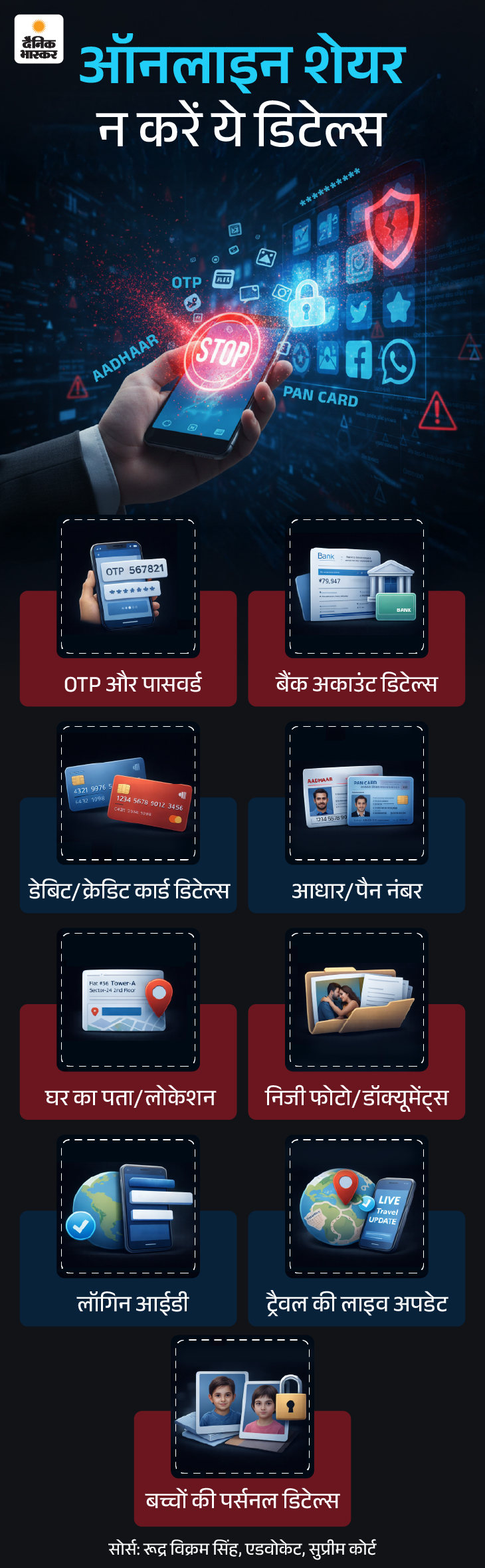
answer- In the online world, even a small information can become a big weapon for cyber fraudsters. Therefore, there is some information which should not be shared online at any cost. Such as-
Question- Many times cyber criminals also steal our personal data fraudulently. What precautions should be taken to avoid this?
answer- Cyber criminals often use social engineering more than technical hacking. Social engineering is a way in which criminals obtain personal information, passwords or OTPs from people by tricking them, scaring them or winning their trust. In such a situation, take special care of some things. Such as-
- Do not immediately trust any unknown call, link or message.
- If someone asks for OTP, password or bank details, then understand that it is a fraud. Real organizations never ask for such information.
- Before clicking on any link, check its URL carefully.
- Always use the official app or website for any banking or government work.
- Avoid doing banking or payments on public Wi-Fi.
- Do not share your personal information on social media.
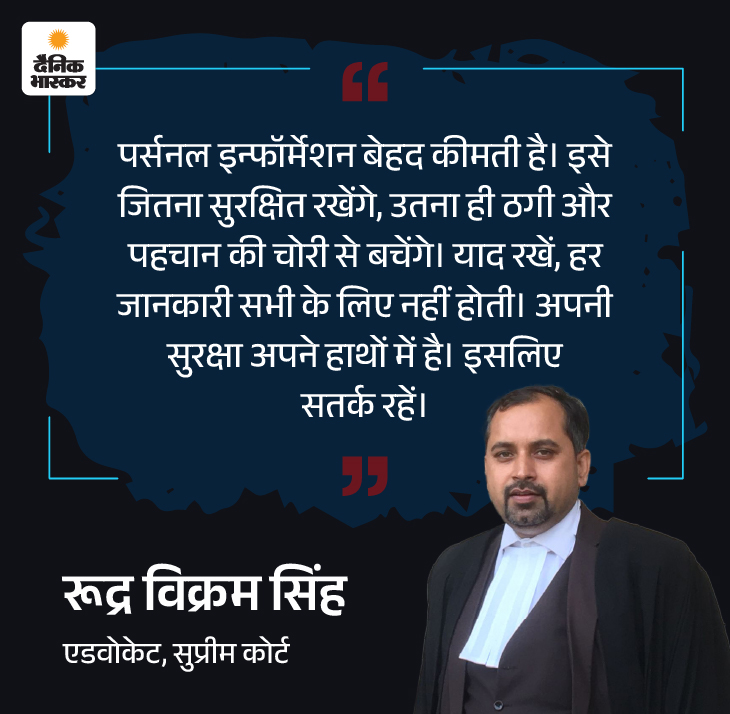
Question- If there is suspicion of online data theft and there has been no misuse of it yet, can we take any precautionary steps?
answer- With this you can save yourself from huge loss. Fast action is the best security in cases of data theft. The sooner you take precautions, the less the risk of fraud.
- First of all, immediately change the passwords of all important accounts, such as email, banking apps and social media.
- Where possible, turn on two-factor authentication (2FA) so no one can login without an OTP.
- Monitor bank account and card transactions regularly. Notify the Bank immediately on any suspicious activity.
- Get your debit/credit card and net banking temporarily blocked immediately.
- If you suspect phishing or fraud, lodge a complaint on the National Cyber Crime Reporting Portal, so that action can be taken in time.
………………
Read this important news also
Important news – Never wear tight jeans: Skinny jeans syndrome may occur, risk of male infertility increases, urologist says.
According to a study recently published in the ‘American Journal of Public Health’, wearing too tight clothes can increase the risk of urinary tract infection (UTI). Read the full news…


&w=360&resize=360,240&ssl=1 "Just drop this thing worth Rs 2 in the toilet! Bastard smell in minutes will be basty smell, bathroom shiny – News-Patiala English")
